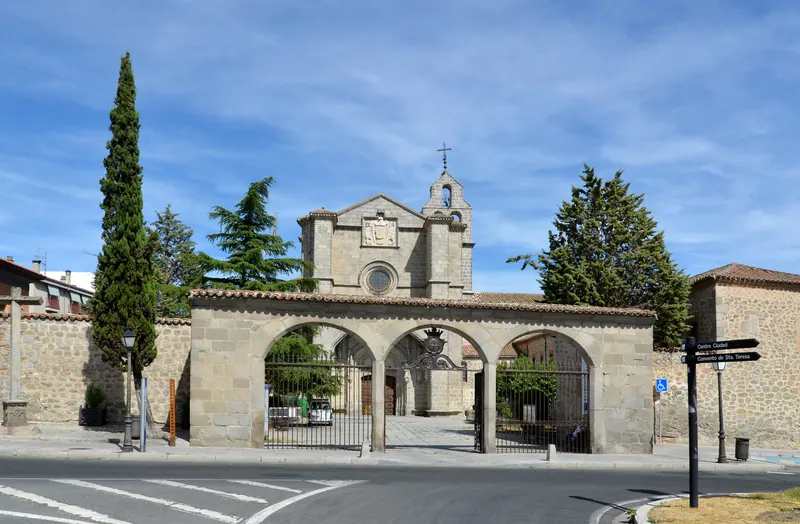
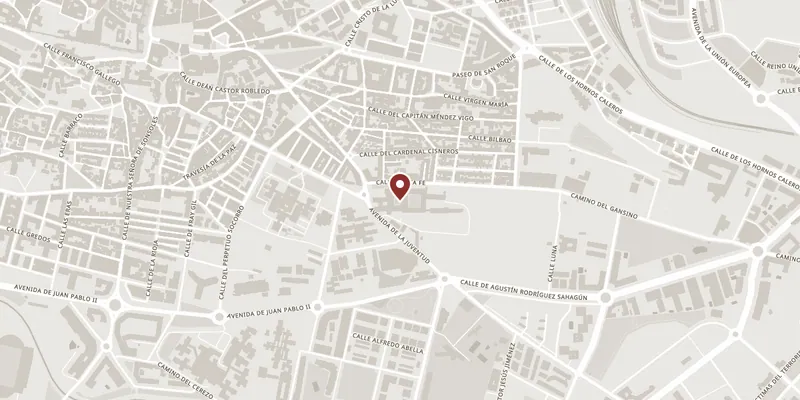
Hernán Núñez Arnalte, treasurer to Ferdinand and Isabella, died leaving money and a will asking Fray Tomás de Torquemada and María Dávila to finish a Dominican convent for him. Work started on 11 April 1482 under Martín de Solórzano and ran to 1493, with the monarchs paying for a great deal of it. They then took it over: the Cloister of Silence and the Cloister of the Kings were built to serve as the court’s summer palace, and the royal apartments are on the visitor route. Torquemada, first Inquisitor General, lived his last years here and died on 16 September 1498.
There are three cloisters, in ascending order of ambition. The Noviciado is small, plain and Tuscan, with a well set off-centre. The Claustro del Silencio is the one to sit down in: Gothic ribbed vaults and carving everywhere — the pomegranates of newly conquered Granada, the yoke and arrows of Ferdinand and Isabella, Dominican shields. It is a building being used as a political statement. The Claustro de los Reyes is the largest and the barest, forty arches below and fifty-six above.
In the church, raised in the middle of the transept, is the sepulchre of Prince Juan, the only son of the Catholic Monarchs, dead at nineteen in 1497 — a death that took the future of the dynasty with it. Domenico Fancelli carved it from Carrara marble in Genoa in 1511–12: the prince recumbent on a truncated-pyramid chest, one of the earliest Italian Renaissance monuments in Spain. In 1809 French troops stripped the silver grille that surrounded it and scattered the prince’s remains, which have never been traced. You are looking at an empty tomb.
Behind the altar, the high altarpiece was begun in 1494 by Pedro Berruguete: five large panels on the life of Thomas Aquinas. The same ticket covers the choir, the royal rooms and the monastery’s museums of Oriental art and natural science, which belong to an entirely different century and can be walked past.