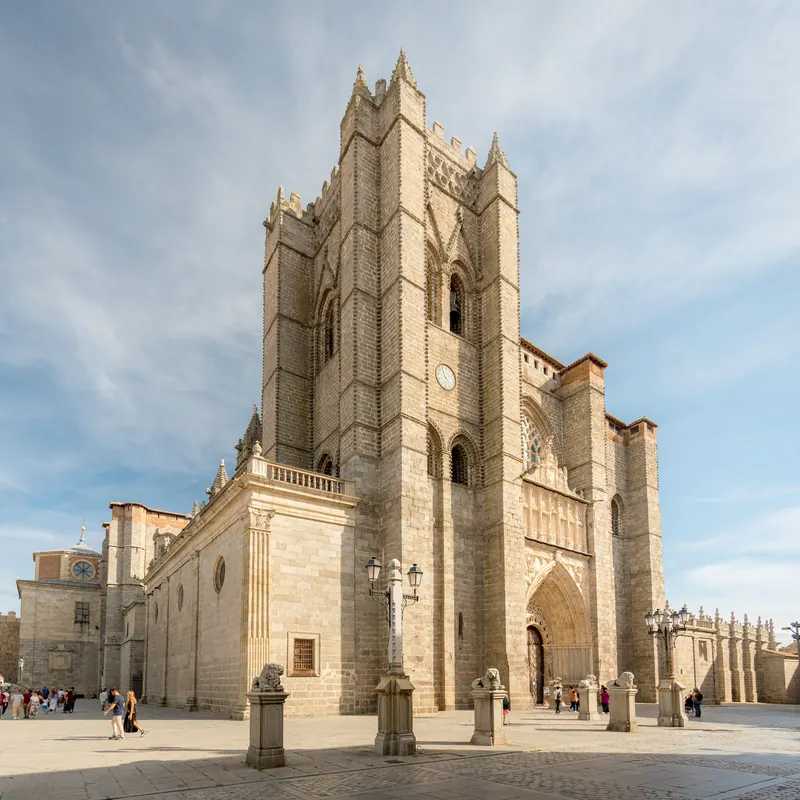
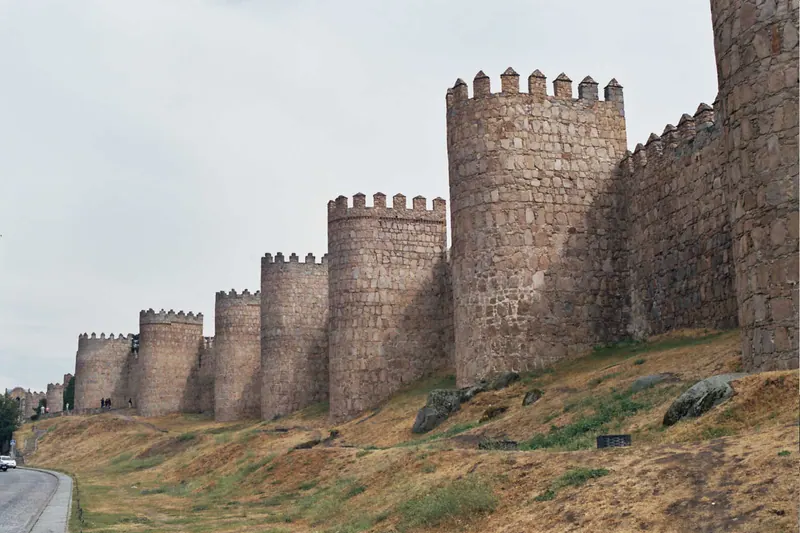
The east end came first, and it was built as a bastion. The cimorro — the local name for the cathedral’s apse — is a solid, crenellated granite drum jammed into the line of the city wall, the largest tower on the circuit, with a double ambulatory inside it and a fighting platform on top. Seen from outside the wall it reads as a keep and you would not guess there is a church behind it. There is nowhere else in Spain where cathedral and curtain wall are this literally the same stone.
Most historians give the design to the master Giral Fruchel, at work from 1172 until his death in 1192, which puts pointed arches and rib vaults in Ávila earlier than anywhere else in the country; the claim that this is Spain’s first Gothic cathedral rests on him. The interior stone is what people remember: a mottled red-and-white sandstone from the Valle de Amblés, veined with iron, known locally as piedra sangrante — bleeding stone. It is used through the apse and the triforium and it makes the east end look bruised.
Three things to find inside. Behind the high altar, in the trasaltar, is the alabaster tomb of Alonso de Madrigal, “El Tostado” — bishop of Ávila, prodigious writer, dead in 1455 — carved by Vasco de la Zarza in the early 16th century and among the best Renaissance sculpture in Castile; the bishop is shown at his desk, still writing. The high altarpiece was painted between 1499 and 1512, begun by Pedro Berruguete. And the chapel of San Segundo occupies the space where a tower of the city wall was demolished in the 16th century to make room for it.
The ticket covers the nave, the ambulatory, the choir, the cloister and the cathedral museum, and includes an audio guide. As of August 2026 the Casa del Campanero and the bell-tower climb are suspended while the cathedral towers are restored, so do not turn up expecting the €3 supplement to buy you a view.