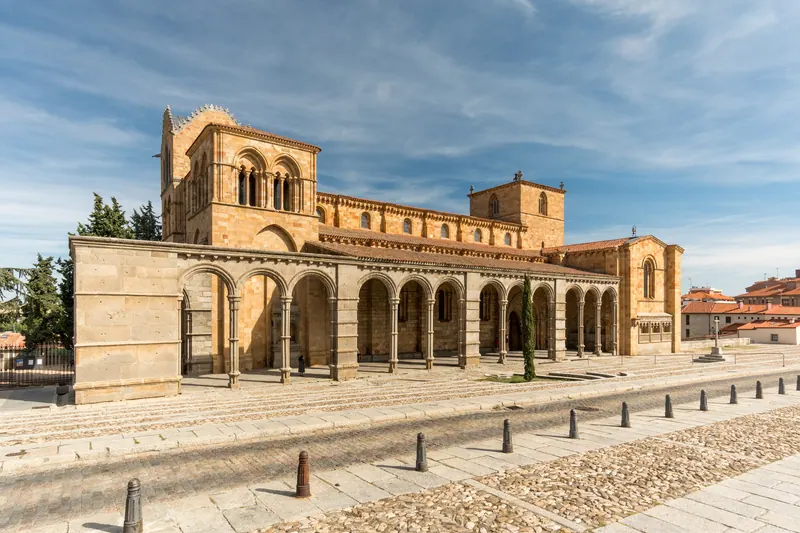
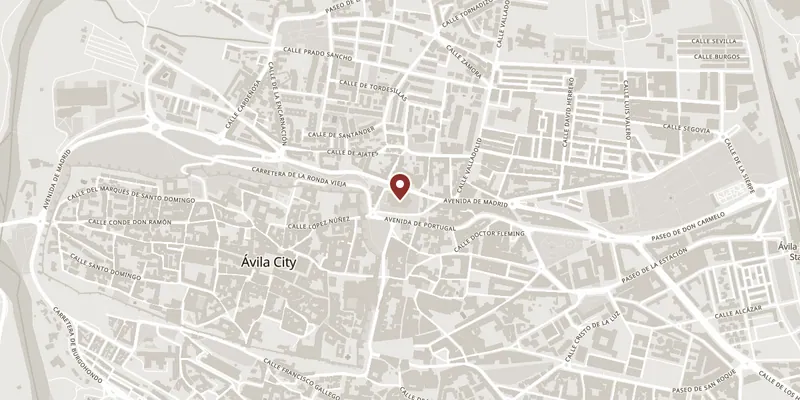
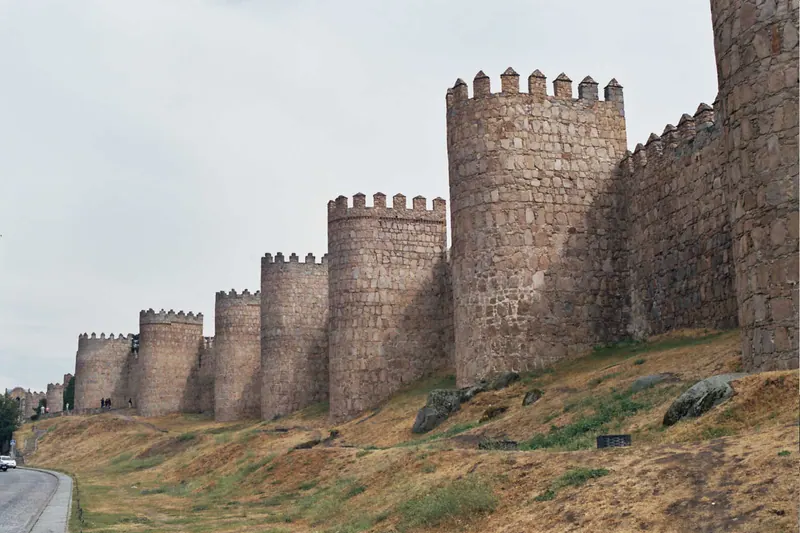
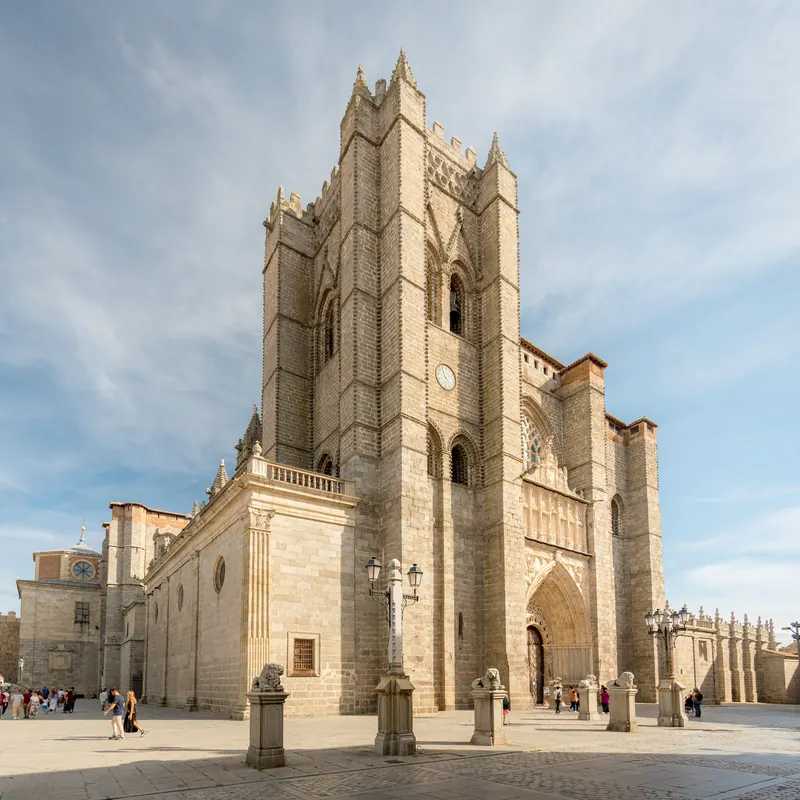
The basilica stands outside the wall, on the slope east of the Puerta de San Vicente, and that is not an accident: Roman practice put executions and burials beyond the town. Tradition places the martyrdom of the siblings Vicente, Sabina and Cristeta here in about 306, under Diocletian. Work on the church you see began around 1120, the towers went up between roughly 1150 and 1170, and the last building is 14th-century. It is the biggest Romanesque church in Ávila and the one that shows the city’s Romanesque was not a modest provincial style.
The west portal is the set piece: a deep recessed doorway of five archivolts, sheltered under a later porch, with Christ on the central pier and the apostles ranged in pairs down the jambs. The drapery and the individual faces get it compared to the Pórtico de la Gloria at Santiago. It survives in this condition because the porch protected it. Stand back on the steps to take it in; up close you lose the arrangement.
Inside, go straight to the cenotaph. It is a stone canopy over a tomb chest, carved in the middle of the 12th century and attributed by the tourist board to the master Fruchel — the man usually credited with the cathedral — and it still carries most of its paint. The sides run the story in continuous strips: the arrest of the three, the refusal to sacrifice, the flight, the capture, the killing. You read it like a comic, left to right. It is among the best Romanesque narrative sculpture anywhere in Spain and it costs €3 to stand in front of.
Below the church the crypt is cut down to the rock the martyrs are said to have died on, and holds the 15th-century image of the Virgen de la Soterraña, co-patron of the city and a devotion of Teresa’s.
Three more Romanesque churches are worth five minutes each on the way past and no more: San Pedro on the Mercado Grande, opposite the Puerta del Alcázar, for its rose window; San Andrés, north of the wall, the oldest and plainest; and the small San Segundo down by the Adaja bridge. All are parish churches with short, unreliable hours — look at the outsides and count it a win if a door is open.