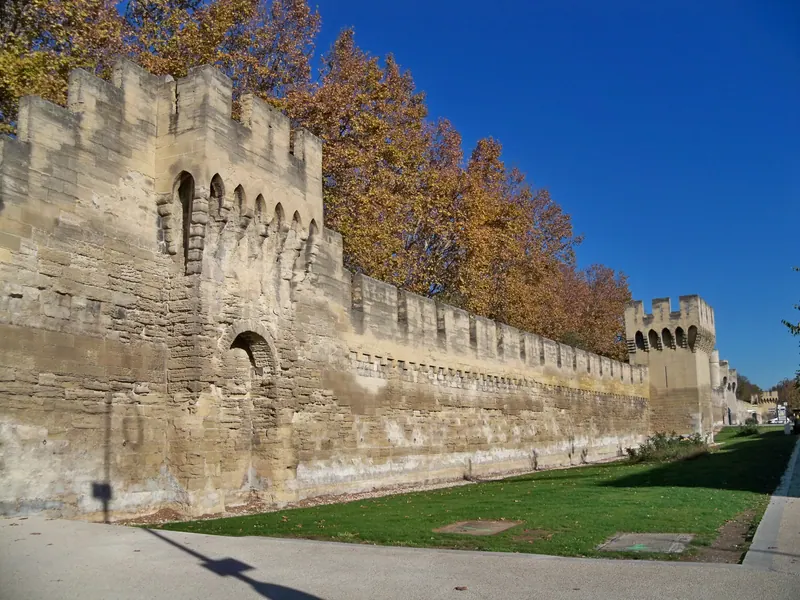
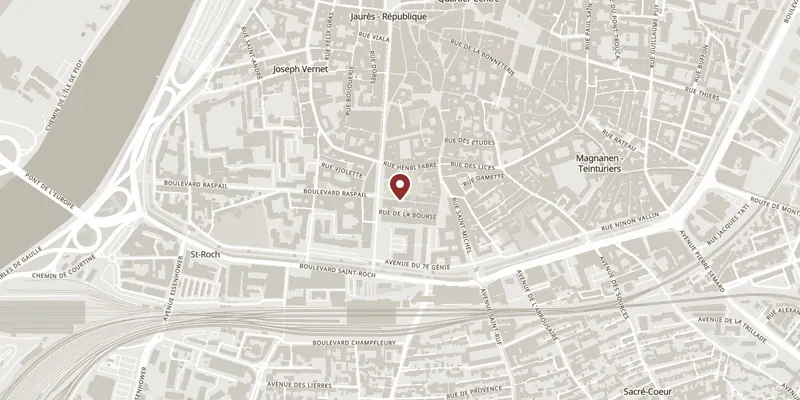
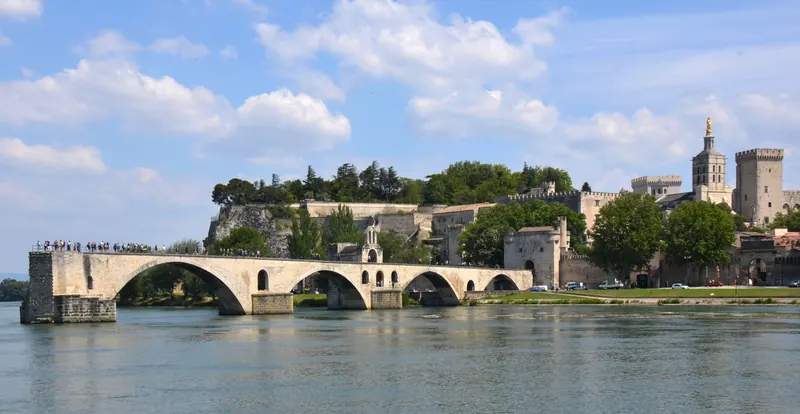
The popes built these because they were frightened. After the Black Death, demobilised soldiers of the Hundred Years’ War formed the Great Companies and rode round southern France extorting towns; Avignon, rich, undefended and full of cardinals, was an obvious target. Innocent VI began the wall in 1355 and it was finished under Urban V by about 1370. It runs roughly 4,330 m, with some 35 large towers and dozens of smaller ones, and it still encircles the old town completely — river frontage included.
Look at the towers as you pass. Almost all of them are square and open at the back, with no rear wall facing the town. That is deliberate: a tower taken by an enemy gives him no shelter and can be shot into from inside the city. The three round ones are on the Rhône side.
What you see is lower than what they built. The ditch was filled in and the ground outside raised, so the curtain now stands on your eye level rather than above it. From 1860 to 1869 the walls were overhauled — the engineers repointed the stonework and thickened the inner face, and Eugène Viollet-le-Duc restored gates, curtain and crenellations, mostly on the southern front. The neat line of merlons and machicolations you photograph opposite the station is largely his. Two medieval gates were lost later and deliberately: a mayor had the Porte Limbert pulled down overnight in 1896 and the Porte de l’Oulle in 1900, and the Porte Saint-Roch and Porte Saint-Lazare were re-cut for traffic.
And here is the catch: this is not Carcassonne. There is no ticketed circuit on top and no continuous parapet walk. The one section you can get up onto is free and short — from the entrance of the Pont Saint-Bénézet you can climb to the wall and follow it through a covered passage and turret up to the Rocher des Doms garden, and that is the whole of it. Everything else is walked, cycled or driven alongside, on the outside, and the tourist office publishes a signed 4.3 km tour of the ring for exactly that.
The wall still does a job: the gates are closed against Rhône floods, which is why the old town stayed dry when the modern quarters did not.