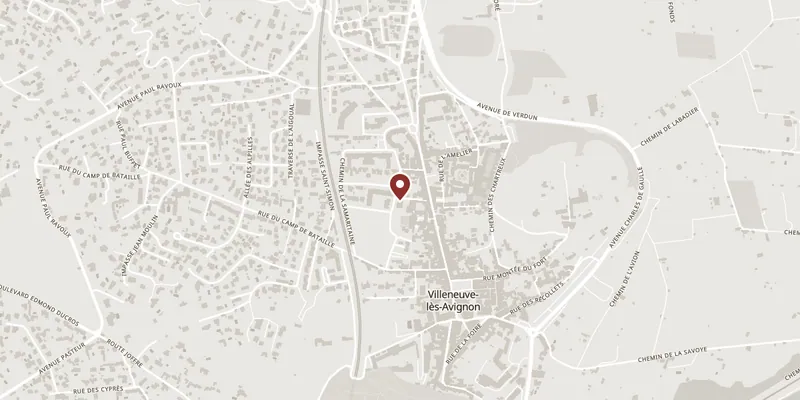
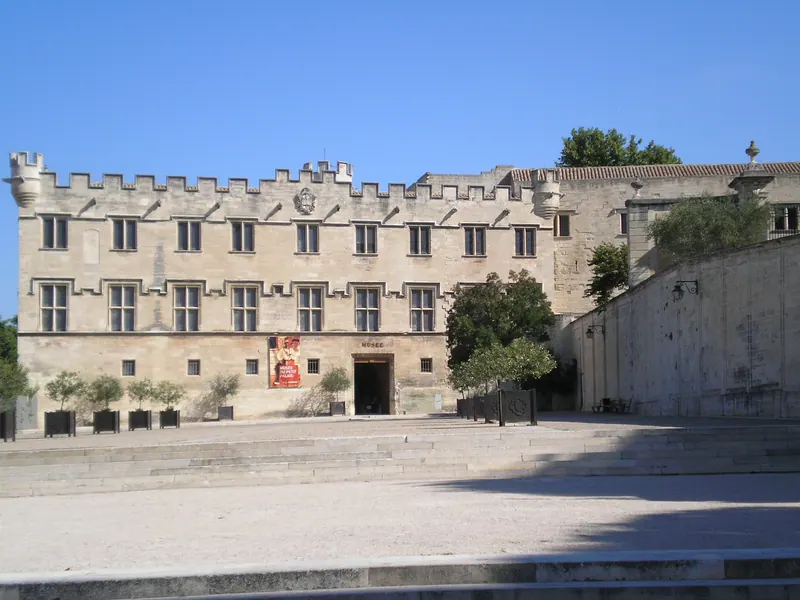
The museum occupies a 17th-century mansion built inside what was the livrée — the private palace — of Cardinal Annibal de Ceccano, one of the great houses of the papal court at Villeneuve. It is four minutes’ walk from the Chartreuse, and the two visits belong together, because the museum holds the Chartreuse’s altarpiece.
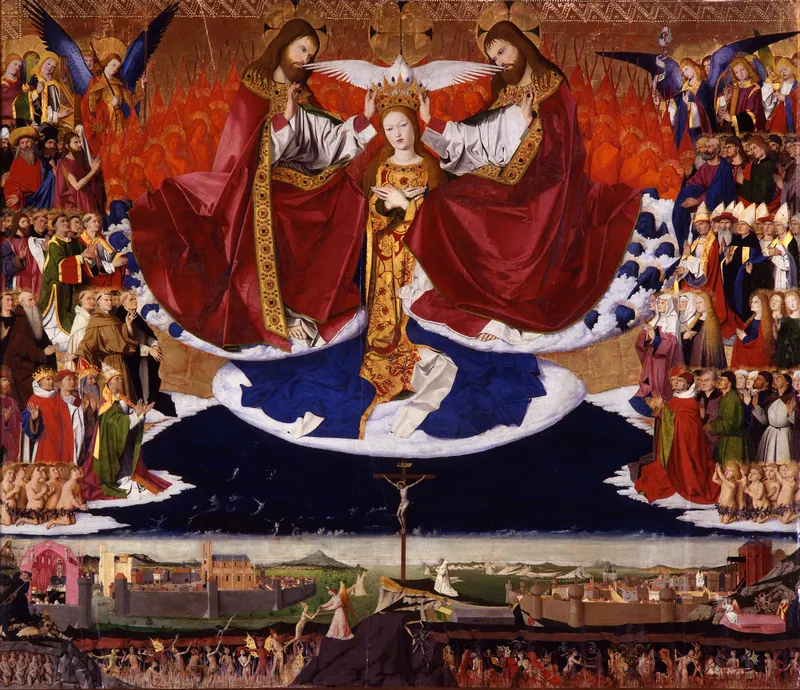
The Coronation of the Virgin was painted by Enguerrand Quarton in 1453–54 for the altar of the Chartreuse church, commissioned by the priest Jean de Montagnac. It is one of the small number of medieval paintings whose commissioning contract survives, and the contract is famous: it specifies, clause by clause, what the painter was to show — the Trinity, with the Father and the Son identical in form, Rome and Jerusalem in the landscape below, paradise, purgatory and hell, and the precise blue to be used. You can stand in front of the picture and read what the client ordered against what the painter delivered. There is very little else like it anywhere.
The second object is the Virgin and Child in ivory, carved about 1310 from a single elephant tusk, which is why she curves: the sculptor followed the natural bend of the tusk, and the whole figure leans in a long S. She came from the Chartreuse treasury and she is usually described as one of the finest pieces of Gothic ivory in France. Look at the traces of the original paint and gilding.
After that the collection is what a rich provincial town accumulates: French religious painting of the 16th to 18th centuries, including Simon de Châlons, Nicolas Mignard, Philippe de Champaigne and Reynaud Levieux. It is good of its kind and it is not what you crossed the river for.
Admission is €4.50, or free with the €20 Villeneuve pass. Out of season it opens afternoons only, and it closes for the whole of January.