Medieval Booker

Landmark ◆ Avignon

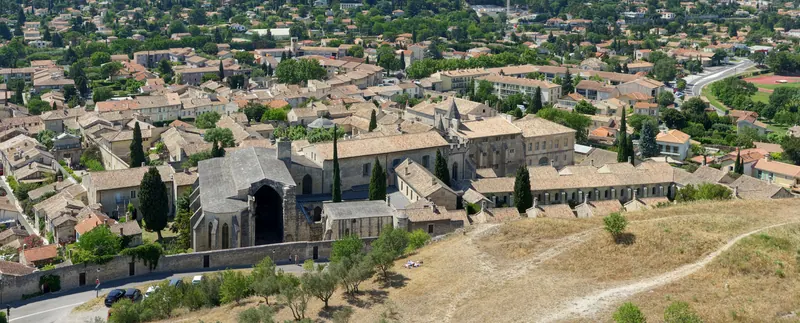
Chartreuse du Val de Bénédiction

The largest Carthusian monastery in France, founded by Pope Innocent VI in the 1350s on his own cardinal's palace, with three cloisters, forty cells and his tomb in the church. The chapel beside the refectory was painted by Matteo Giovannetti in 1355 — the same hand as the Palais des Papes, without the queue. Find the Tinel and it is next door.

Where and when

Where
58 rue de la République, 30400 Villeneuve-lès-Avignon, Avignon, France Open in Google Maps Walking directions
Era
Founded by Innocent VI from 1353–56; Giovannetti frescoes 1355; sold and broken up at the Revolution; restored from 1909
Opening
Tuesday–Sunday, closed Mondays except Easter Monday and Whit Monday. Mid-April to mid-October 09:30–18:30; mid-October to mid-April 10:00–13:00 and 14:00–17:00; open daily 09:30–18:30 in July and August. Last ticket 30 minutes before closing. Closed 1 January, 1 May, 1 and 11 November, 25 December, and for a fortnight in early January (as of August 2026)
Price
€8 adult, €6.50 reduced (18–25, teachers, groups of 20+), free under 18 and for several other categories. Guided visit +€1. Lantern-lit evening tours €9. The €20 PASS Monuments & Musée Villeneuvois covers it with four other sites for a year (as of August 2026)
Best time
A weekday morning. Self-guided takes about 45 minutes; the 75-minute guided tour runs Sunday mornings at 11:00 from October to May, with Saturdays added in summer and daily 10:00 tours in July and August.
Good for
Quiet cornerGood with children
Official site
chartreuse.org
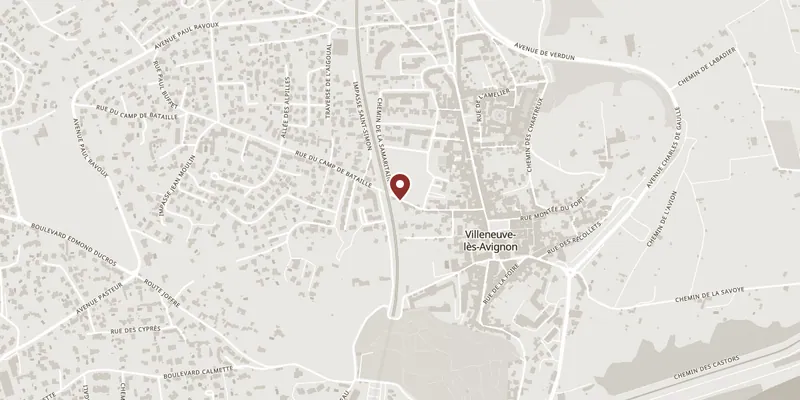
Map showing where Chartreuse du Val de Bénédiction is
Open in Google Maps Walking directions © MapTiler © OpenStreetMap contributors

Checked

What is Chartreuse du Val de Bénédiction?

Innocent VI was elected in 1352 and immediately gave away his own house. His cardinal’s residence at Villeneuve, plus land around it, became the Chartreuse Notre-Dame-du-Val-de-Bénédiction, planned first for twelve monks and expanded by his successors until it was the biggest charterhouse in France: a church, three cloisters, a chapter house, a refectory, a laundry, gardens, and forty individual cells, each a small house with its own walled garden, because Carthusians live as hermits who meet only for the offices. Walking the great cloister and looking into the cells is the clearest picture in France of how that order actually worked.

The reason for our audience to cross the river is the Chapelle des Fresques, dedicated to St John the Baptist and standing next to the Tinel. Matteo Giovannetti — the Viterbo priest-painter who did the Chapelle Saint-Martial in the Palais des Papes — painted it in 1355: the life of the Baptist, framed in painted trompe-l’œil architecture, under a ceiling of blue and emerald sky with pink clouds and angels. Much of the upper register has gone, and the losses are honest and visible. But the chapel is small and rarely busy, which after the queues in the palace is the whole difference: here you can stand still in front of Giovannetti’s work for as long as you like.

Innocent VI’s tomb is in the funerary chapel on the south side of the church. He ordered it in his own lifetime, from 1361, from the master of works of the papal palaces; the effigy rests on a lion, on a chest of Pernes stone that once held rows of small alabaster figures. At the Revolution the monastery was sold off in lots, the tomb ended up in the house of a vine-grower who broke up the base to make a cupboard and sold the statues one at a time, and after Prosper Mérimée intervened it went to the town hospice. It was put back in the church in 1959.

One piece of practical unfairness: the monastery’s greatest painting is not here. Enguerrand Quarton’s Coronation of the Virgin was commissioned in 1453 for this church and now hangs in the Musée Pierre-de-Luxembourg, a few minutes’ walk away.

Since 1973 the buildings have housed the national centre for playwriting, so parts of it are a working artists’ residence.
What visitors say

4.5 from 1,317 ratings

  • brendan murray

    5 out of 5 3 months ago

    This place was great. Got a little hand book which allowed you to read info at your own place. Very beautiful and intreging place. And contains the actual mausoleum of Pope Innocent. This was a little unknown gem. Even trying find it for review was hard.

    Read this review on Google
  • Leendert van der Ent

    5 out of 5 3 months ago

    Vast medieval complex with a chapel with magnificent freacoes by Giovanetti

    Read this review on Google
  • Seokjin Ham

    5 out of 5 a year ago

    Founded in 1356 by Pope Innocent VI, this former Charterhouse monastery became one of the most important Carthusian complexes in France. Since 1973, it has been transformed into France’s National Center for Dramatic Writing, serving as a creative and research space for playwrights, directors, choreographers, and other performing artists. Visitors can explore the preserved monastic architecture—including the monks’ cells and corridors, chapel, and gardens—independently of its artistic function. ※ Included in the Avignon City Pass.

    Read this review on Google

Ratings and reviews from Google. See all on Google Maps

Frequently asked questions

Who founded the Chartreuse at Villeneuve-lès-Avignon?

Pope Innocent VI, elected in 1352, who gave his own cardinal's residence and land at Villeneuve to the Carthusians in the 1350s. It grew into the largest charterhouse in France, with three cloisters and forty cells.

Are there frescoes by the Palais des Papes painter at the Chartreuse?

Yes. Matteo Giovannetti, who painted the Chapelle Saint-Martial in the Palais des Papes, painted the Chapel of St John the Baptist here in 1355 with the life of the Baptist. It stands next to the Tinel and you can look at it from a metre away.

Where is Pope Innocent VI buried?

In the funerary chapel on the south side of the Chartreuse church at Villeneuve-lès-Avignon. He commissioned the tomb in his own lifetime from 1361; it was broken up and sold at the Revolution and returned to the church in 1959.

How much is the Chartreuse de Villeneuve?

€8 for an adult and €6.50 reduced, free under 18, as of August 2026. A guided tour is €1 extra. The €20 Villeneuve pass covers it with the Fort Saint-André, the Abbaye Saint-André, the Musée Pierre-de-Luxembourg and the Tour Philippe-le-Bel for a year.

How long does the Chartreuse take to visit?

About 45 minutes unguided, taking in the church, the chapel of frescoes, the three cloisters, the chapter house, the laundry, the gardens and the monks' cells. Guided tours run about 75 minutes.

Festivals in Avignon

Medieval festivals in Avignon
Reenactment & Battles Medieval Markets & Fairs +1

Festival Médiéval de la Rose d'Or

Avignon, France

Every autumn some 60 to 70 historical associations camp on the Île de la Barthelasse, the island in the Rhône facing the Palais des Papes, for a re-enactors' festival with a market, archery, tournaments and a closing battle. Running since 2007 and organised by volunteers without public subsidy, it is one of the largest medieval gatherings in southern France; the 2026 edition, billed as the twentieth, falls on 10–11 October.

2026
Family

More places in Avignon

Places in Avignon
Castle Start here

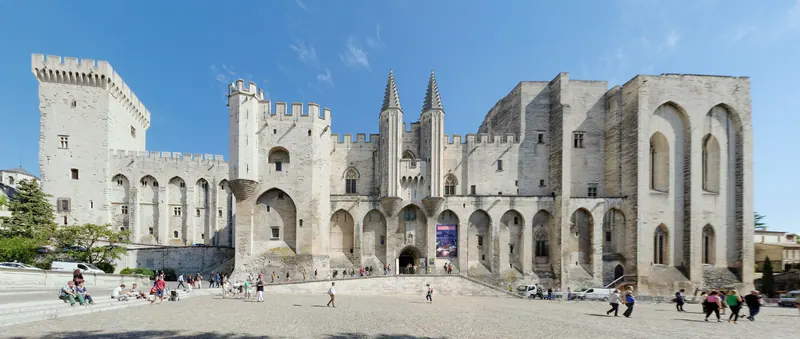
Palais des Papes

Palais Vieux from 1335 under Benedict XII, Palais Neuf from 1342 under Clement VI; papal residence to 1403; prison and barracks until 1906

Two palaces welded together — Benedict XII's fortress of 1335 and Clement VI's wing of 1342 — and at roughly 15,000 m² the largest Gothic palace in Europe. The rooms are bare because the army used them as a barracks for a century, so go for the four painted spaces that survived and find the Chambre du Cerf first.

Good with children Works in the rain
Walking directions
Museum

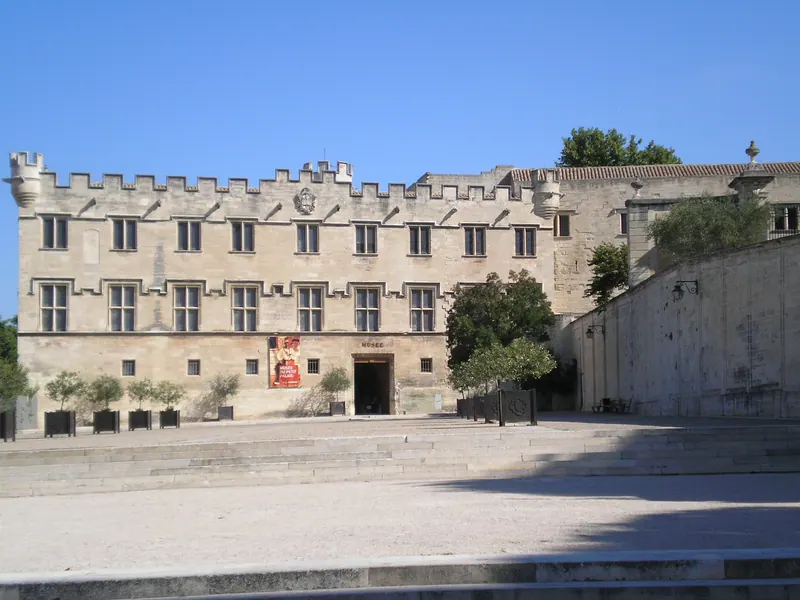
Musée du Petit Palais

Cardinal's livrée from the 1310s; archbishops' palace from 1475, rebuilt by Giuliano della Rovere (later Julius II); museum since 1976

The archbishops' palace at the top of the Place du Palais, free to enter, holding over 300 Italian paintings from the Campana collection alongside the best room of 14th-century Avignon sculpture anywhere. Find the fragments of Cardinal Jean de Lagrange's tomb — the earliest French transi, a cardinal carved as a rotting corpse.

Works in the rain Free or cheap Quiet corner
Walking directions
Landmark

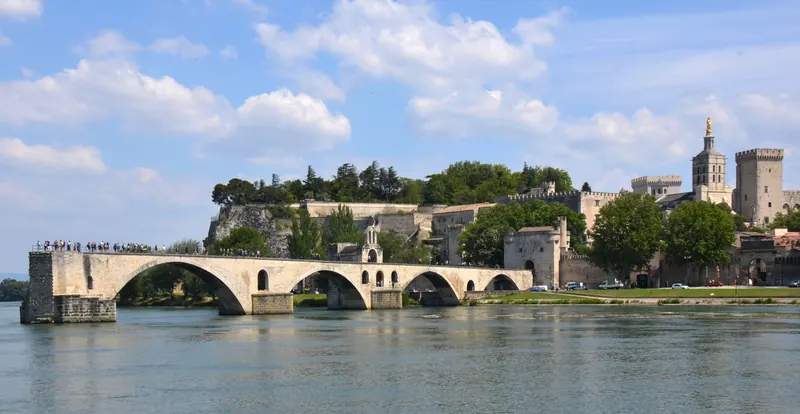
Pont Saint-Bénézet

Built from the late 12th century, traditionally begun 1177; 22 arches originally, 4 today; abandoned after the flood of 1669

Four arches of a bridge that once had twenty-two and ran some 900 m across both channels of the Rhône, abandoned in the 17th century after the river knocked it down once too often. Walk out to the end, look at the two-storey chapel built into the second pier, then read the honest note below about the song.

Good with children Free or cheap
Walking directions