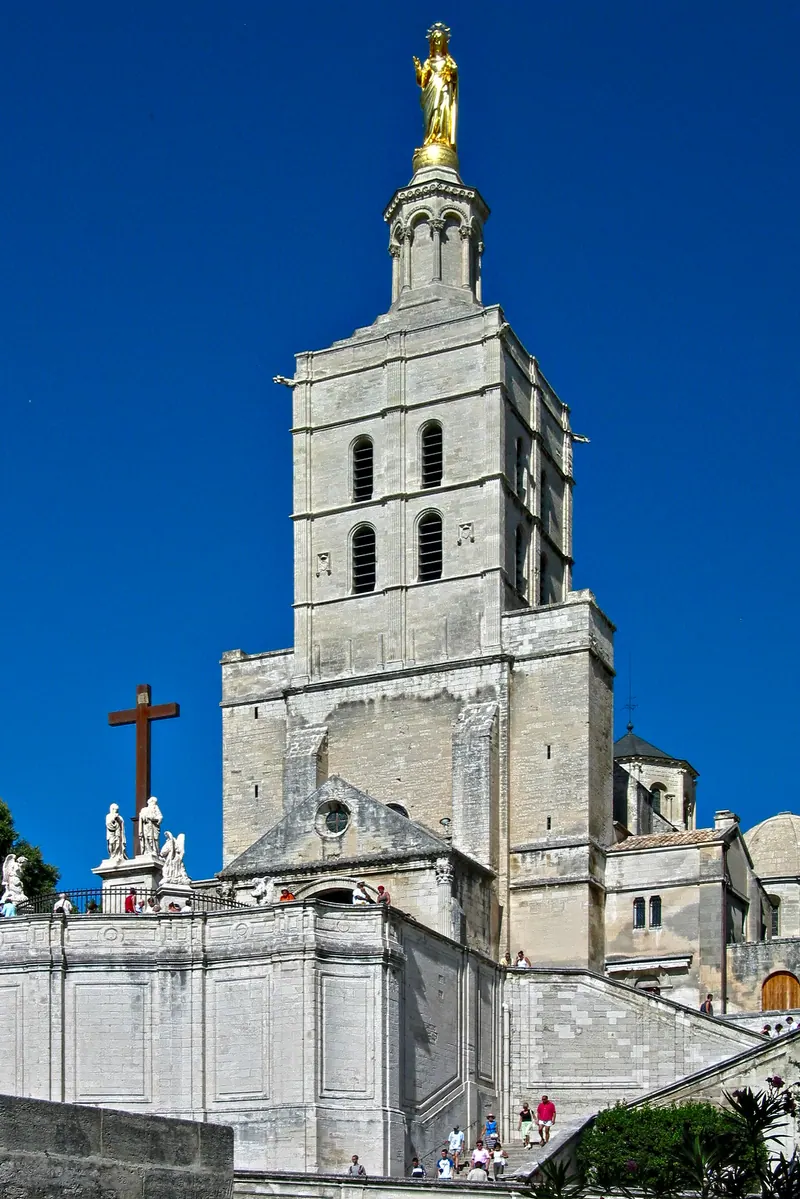
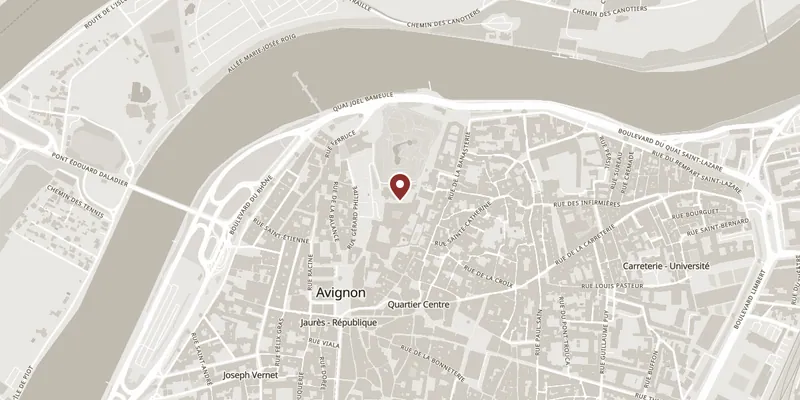
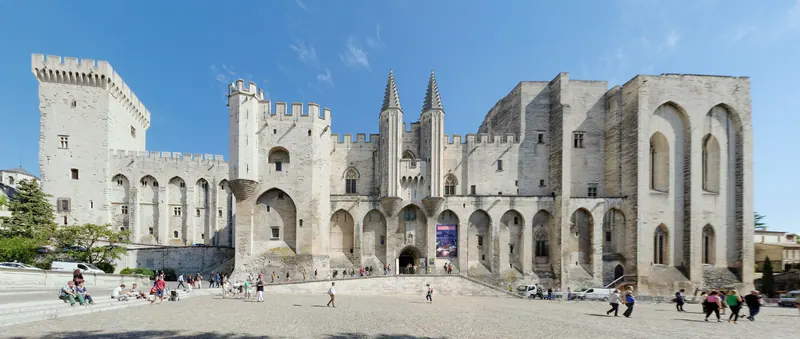
The cathedral came first. It was built around 1150 in Provençal Romanesque — heavy, plain, round-arched — and the popes simply annexed the rock beside it from 1335. The result is the odd silhouette on the Place du Palais: a small 12th-century church wedged against the largest Gothic palace in Europe.
The porch is the first thing to look at, and it is not Romanesque-looking at all: a triangular pediment on fluted columns with Corinthian capitals, copied from Roman work in the region. From 1336 Cardinal Jacopo Stefaneschi commissioned Simone Martini, the Sienese master, to paint frescoes on it. Do not look for them here. What survives — mainly the sinopie, the red underdrawings on the wall beneath the lost paint, showing Christ blessing and a Virgin and Child — was lifted and is displayed in the Palais des Papes next door. It is one of the strongest reasons to buy the palace ticket.
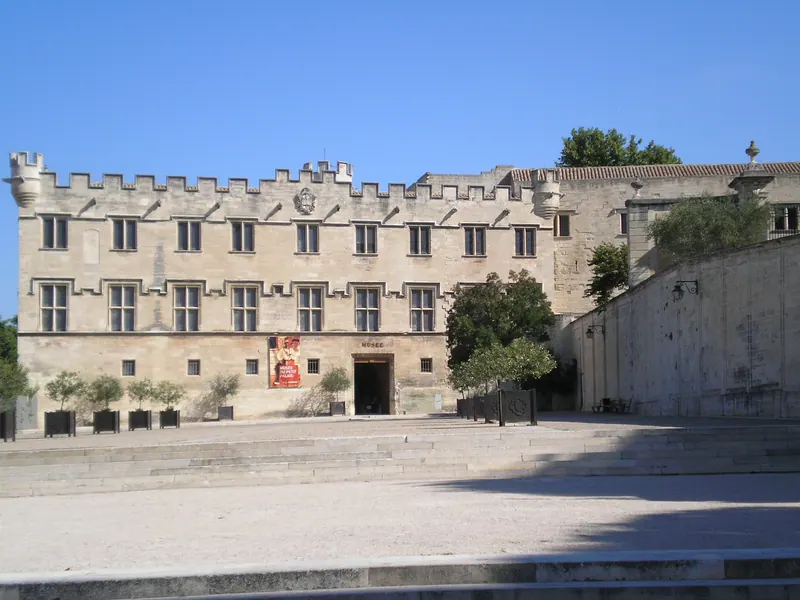
Inside, the building is a single Romanesque nave with an octagonal dome, hung about with Gothic and later side chapels added between the 14th and 17th centuries. Three things are worth hunting for. The tomb of Pope John XXII (d. 1334) stands in the chapel built for it on the south side — a tall flamboyant canopy of Pernes stone, attributed to an English sculptor, and the grandest papal tomb left standing in France. It was mutilated at the Revolution and clumsily patched afterwards; the little mourner figures from its funeral procession were dispersed, and some of them are now in the Petit Palais fifty metres away, which is a good reason to do both in one morning. The cathedral treasury was installed around the tomb in 1993. Benedict XII, the pope who began the palace, has a second Gothic tomb here. And the cathedra — the white marble bishop’s throne of the 12th century, carved with a lion for St Mark and an ox for St Luke — is the oldest thing in the building.
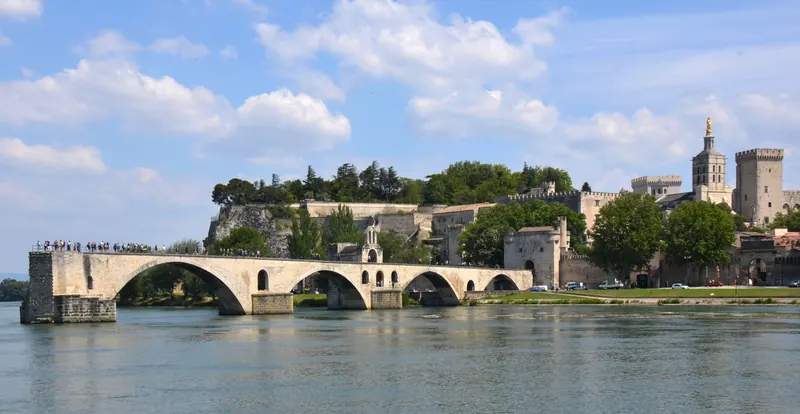
The enormous gilded Virgin on the tower is not medieval: a lead statue of four and a half tonnes, put up in 1859 and re-gilded for the Jubilee in 2000. It is what you see from every street in Avignon.
Entry is free. It is a working cathedral, the seat of the archbishop, and it closes for services.