Medieval Booker

Jousting & Tournaments ◆ Italy

Giostra del Saracino

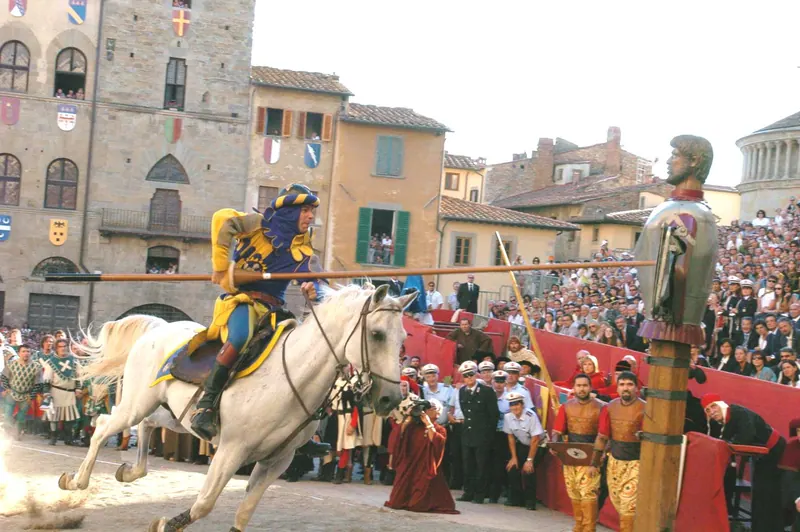
The Giostra del Saracino is a mounted joust in Arezzo's Piazza Grande in which knights of the city's four quarters charge a wooden Saracen, the Buratto, for a golden lance. It is run twice a year, on the penultimate Saturday of June at night and on the first Sunday of September in the afternoon, after a day of ceremonies and a costumed historical procession; in its modern form it dates from 1931.

When is Giostra del Saracino 2027?

Next edition
2027 Giostra del Saracino 2027 See all editions
Where
Arezzo, Italy
Also called
Joust of the Saracen · Saracen Joust · Giostra del Saracino Arezzo · Giostra di San Donato
How often
Every year
Entry
Piazza Grande ticketed, standing places included. September 2026: stands €30-100 (reduced €20-90), standing €10 (reduced €6), general rehearsal €2-7; children 0-4 held in arms free; reduced for ages 5-14 and over 70. On sale about a week before each joust at Palazzo Comunale, then online at discoverarezzo.ticka.it; sells out fast.
Family-friendly
Yes — bring the kids
Founded
1931

Checked · we re-check every festival twice a year.

Past and upcoming editions

Editions of Giostra del Saracino
EditionDatesStatusCalendar
151st edition 2027 Google Calendar · .ics · Get tickets
152nd edition 2027 Google Calendar · .ics · Get tickets
Past editions (2)
  • 149th edition — 20 June 2026
  • 150th edition — 6 September 2026

What happens at Giostra del Saracino?

The Giostra del Saracino is a mounted joust held twice a year in Piazza Grande, the sloping medieval square of Arezzo in eastern Tuscany: on the penultimate Saturday of June as a night joust, and on the first Sunday of September by day. Eight jousters, two for each of the city’s four quarters (Porta Crucifera, Porta del Foro, Porta Sant’Andrea and Porta Santo Spirito), charge in turn along a packed-earth track, the lizza, at the Buratto, a spring-loaded wooden Saracen holding a shield and a flail. The pair with the highest score wins the Lancia d’Oro, the golden lance, for their quarter. Jousts were held in Arezzo from the 16th to the late 17th century; the custom died out in the early 19th century and was officially revived in 1931. The September 2026 joust was the 150th, and the official roll of honour shows Porta Sant’Andrea winning both 2026 editions, reaching 41 victories, level with Porta Santo Spirito.

The joust ends a full day of ritual. On the morning of the September joust a herald reads the proclamation, the Bando della Giostra, at stops around the centre from 11am; in the early afternoon the jousters are blessed in their quarters’ churches and the bishop blesses the procession in front of the cathedral. At 3:30pm the historical procession, with around 400 costumed participants according to the official site, sets off for Piazza Grande. At 5pm the flag-wavers perform, the men-at-arms and the eight jousters enter, the herald reads the Buratto’s challenge and the runs begin. The mayor presents the golden lance to the winning quarter, followed by a Te Deum in the cathedral. In June the same ritual moves into the evening: in 2027 the procession leaves at 8pm and the entry into the square is at 9:30pm.

The days before each joust belong to the event too: the presentation of the golden lance, the draw for the running order with the captains’ oath, trial runs in Piazza Grande, a race simulation and a ticketed general rehearsal (Prova Generale) two nights before. For June 2027 these run from 11 to 17 June, for September from 28 August to 3 September, and on the eve of each joust the quarters hold dinners in the squares by their headquarters.

Piazza Grande is ticketed for the joust and the rehearsal, standing places included. The Comune di Arezzo sells tickets about a week before each joust, first seats at the box office in the I Colori della Giostra exhibition in Palazzo Comunale (Piazza della Libertà 1), four per person, then standing places and rehearsal tickets, also online at discoverarezzo.ticka.it. In September 2026 seats cost €30 to €100 (€20 to €90 reduced), standing places €10 (€6 reduced) and rehearsal tickets €2 to €7; children up to 4 held in arms went free, and ages 5 to 14 and over-70s paid reduced prices. Demand is high: in June 2026 the seats were gone within hours and some people slept outside the box office. Pets are not allowed in the square.

Arezzo is on the Bologna-Rome railway, with Intercity and Frecciarossa trains to Florence and Rome, and next to the A1 motorway (exit Arezzo). Car parks listed by the organisers include the Mecenate multistorey, about 1.2 km from the centre, and the free Tarlati car park, about 800 m away.
Frequently asked questions

When is the Giostra del Saracino 2027?

The 2027 calendar, approved in November 2026, sets the 151st joust for Saturday 19 June 2027 (night joust, entry into Piazza Grande at 9:30pm) and the 152nd for Sunday 5 September 2027 (entry into the square at 5pm).

How much are tickets and when do they go on sale?

In September 2026 seats cost €30 to €100 and standing places €10, with reduced prices for ages 5 to 14 and over-70s; children up to 4 held in arms went free. Sales open about a week before each joust at Palazzo Comunale, then online at discoverarezzo.ticka.it, and seats go within hours.

How does the joust work?

Eight jousters, two per quarter, charge in turn at the Buratto, a spring-loaded wooden Saracen with a shield and a flail. The pair with the highest combined score wins the golden lance; a lance that breaks on the Buratto can double the score, and ties go to extra runs.

Which quarters compete?

Porta Crucifera (green and red), Porta del Foro (yellow and crimson), Porta Sant'Andrea (white and green) and Porta Santo Spirito (yellow and blue). After 2026, Sant'Andrea and Santo Spirito lead the roll of honour with 41 wins each.

Can I see anything without a ticket?

Entry to Piazza Grande for the joust and the general rehearsal is ticketed, standing places included. The herald's proclamation, the blessing in front of the cathedral and the procession take place in the streets of the centre beforehand.

Is it suitable for children?

Yes, with planning: children up to 4 held in arms enter free and ages 5 to 14 pay reduced prices. The June joust starts at 9:30pm, and pets are not allowed in the square.

More medieval festivals in Italy

Same country, upcoming first.

All festivals in Italy
  • Medieval Markets & Fairs Living History & Museums +1

    Monteriggioni di Torri si Corona (Monteriggioni Medieval Festival)

    Monteriggioni, Italy

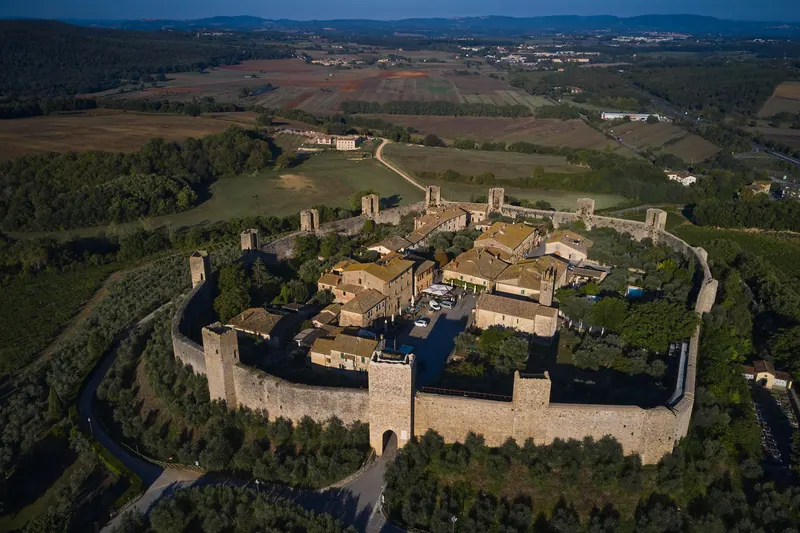
    Monteriggioni's 'di Torri si Corona' festival fills the tiny walled hilltop village near Siena with costumed performers, craft stalls, taverns, games and encampments over a long weekend in July. It has run since 1990 and takes its name from Dante's line in the Inferno describing the castle's crown of towers.

    Expected 2027
    Family
  • Medieval Markets & Fairs Music, Feasts & Theatre +1

    Festa dell'Unicorno

    Vinci, Italy

    The Festa dell'Unicorno takes over the walled centre of Vinci, Leonardo's hill town, for three days each July with themed 'worlds' that range from a medieval citadel with market and knights to steampunk, cosplay, comics and horror, plus hundreds of shows and concerts and some 200 market stands. The medieval backbone is the town itself, its castle of the Conti Guidi and the knights' quarter and market; the rest is openly fantasy, and it is Italy's largest festival of the kind.

    Expected 2027
    Family

Other jousting tournaments

All jousting tournaments
  • Jousting & Tournaments Living History & Museums

    Middelaldercentret (The Medieval Centre), Nykøbing Falster

    Nykøbing Falster, Denmark

    Middelaldercentret is an experimental living-history museum on the Guldborgsund opposite Nykøbing Falster, where a reconstructed Danish market town of around the year 1400, Sundkøbing, is populated by costumed staff who stay in character all day. Its season runs from early May to late September with daily trebuchet firing, jousting and craft demonstrations, plus an autumn-holiday week in October and a Christmas market.

    – 2026
    Family
  • Viking & Norse Historic City Celebrations

    Scalloway Fire Festival

    Scalloway, Scotland

    Scalloway's Viking fire festival opens Shetland's fire-festival season on the second Friday of January: a Guizer Jarl and a squad of men, women and children in Norse dress lead the torchlit procession through the village to the boating club slipway at Port Arthur, where the galley is set alight and cast adrift on the sea before a fireworks display and a night of hall performances. The next edition is Friday 8 January 2027.

    2027
    Family
  • Featured
    Music, Feasts & Theatre Viking & Norse +1

    Up Helly Aa (Lerwick)

    Lerwick, Scotland

    Up Helly Aa is Lerwick's Viking-themed fire festival, held on the last Tuesday of January: about a thousand torch-bearing guizers led by the Guizer Jarl's squad in Norse dress march through the town and burn a full-size replica longship, then tour a dozen halls performing skits until morning. It grew out of 19th-century tar-barrelling, with the first torch procession in 1881 and the first galley burning in 1889; the next edition is Tuesday 26 January 2027.

    2027
    Family